Welcome!

"In many ways, the work of a critic is easy. We risk very little yet enjoy a position over those who offer up their work and their selves to our judgment. We thrive on negative criticism, which is fun to write and to read. But the bitter truth we critics must face, is that in the grand scheme of things, the average piece of junk is probably more meaningful than our criticism designating it so. But there are times when a critic truly risks something, and that is in the discovery and defense of the new."
-Anton Ego, Ratatouille

With aspirations to become an arts/entertainment reporter or critic, I have started this website to post weekly reviews of the latest cinematic offerings from Hollywood and around the world. Currently studying Film and Journalism at Carleton University in Ottawa, Ontario, I hope my reviews here are the start to a long and fulfilling road down the path of reporting.

Saturday, June 8, 2013

Use Your Illusions, Abuse Your Story


Now You See Me

**½  out of ****

Directed by: Louis Leterrier

Starring: Mark Ruffalo, Jesse Eisenberg, Woody Harrelson, Isla Fisher and Morgan Freeman

Running time: 115 minutes


Magic’s influence on the cinema goes back to the late 19th century. Many early films, which stretched at that time to a whopping five minutes, displayed simple conjuring acts taken directly from the vaudeville stage or a magician’s repertoire. The magic was striking and memorable, and the new breakthrough of film gave performers a new resort to present their most alluring tricks.

Later on, when the cinema focused more on the story and characters than flash-in-the-pan spectacles, filmmakers like Buster Keaton and Georges Méliès integrated the magic into the plot. More often than not, though, the main attraction that courted and pleased the crowds were the miraculous effects; the story was secondary.

That spirit for spectacle is omnipresent in Now You See Me, a new mystery set in the realm of performance magic. The film is a polished and briskly paced thriller that emphasizes the intrigue and dazzle associated with visual trickery over plot coherence and character dynamics.


Now You See Me focuses on four performers: obnoxious street magician J. Daniel Atlas (Jesse Eisenberg), equally obnoxious mentalist Merritt McKinney (Woody Harrelson), daredevil Henley Reeves (Isla Fisher) and pickpocket Jack Wilder (Dave Franco). Their brief character intros at the start are witty but, unfortunately, misdirection: we only remain with these folks intermittently throughout the film.

Instead, the protagonist is Dylan Rhodes (Mark Ruffalo), an FBI agent called to investigate the four aforementioned illusionists – who have renamed themselves The Four Horsemen and put on elaborate shows for enthusiastic, sell-out crowds. At a Horsemen show in Las Vegas, the four concocted a trick that teleported an audience member straight to the vault of a Parisian bank.

Authorities apprehend the Horsemen after the $3 million stored in that vault rains down on the Vegas audience. In that crowd is Thaddeus Bradley (Morgan Freeman), an ex-magician who revived his career and his bank account by exploiting magicians’ secrets to millions of online viewers.


Bradley helps Rhodes and his Interpol partner, Alma Vargas (Melanie Laurent), learn the secrets behind the tricks of that trade, as the police track the Horsemen to shows in the Big Easy and the Big Apple. The magic makers may be breaking the law to keep their elaborate ruses working.

Now You See Me comes from director Louis Leterrier, who helmed the first two Transporter films, and keeps on with those films’ manic, throttling action and ludicrous plotting.

A fan of sweeping camera shots, Leterrier also uses the point-of-view shot to dazzle the moviegoing audience as the Horseman's crowd, as well. In an early scene, Atlas performs a trick where he tells a woman to choose a card from a deck he flips through quickly. Viewing the scene from her eyes, we notice that Atlas pauses briefly when the seven of diamonds appears. Alas, the woman chooses that card, too.

Since the four performers are such cunning directors of audience attention, complete with playful quips and personality, they please the crowds in the fictional story world about as much as they attract interest from Now You See Me's audience. Those who find it hard to resist riveting showmanship will become easily absorbed in the surprises and revelations.


However, the more that screenwriters Ed Solomon, Boaz Yakin and Edward Ricourt rely on the same tricks the magicians do in intriguing the crowds – misdirection and mirrors, primarily – the easier it is to see through later plot twists.

During the final act, that time when a thriller is required to up the stakes, one has become so accustomed to the tricks already thrown at the audience that one knows what to expect. The intrigue and thrills dilute what has been a riotously entertaining ride so far.

As an ensemble vehicle that champions the complexity of convoluted storytelling, it is hard to identify with any of the characters. The sly magicians are fun performers to watch, but their icy cocksureness (and their resilience to ethics) makes them hard to root for.


Meanwhile, Ruffalo and Laurent fare a bit better, although since they are compulsively chasing the Horsemen around, the spark of romance between them gets little room to work its own magic. The best scenes in Now You See Me, unsurprisingly, come from Freeman and Michael Caine, the latter of whom appears in an extended cameo as the Horsemen’s insurer. Watching these veteran actors engage in sly chitchat is short-lived but delightful.

The film’s opening voice-over informs the audience not to look too closely. If you do, you are going to have many plot holes to sift through. The more one enjoys this crafty and often surprising thriller depends on how often one stops to ponder about the mechanics of the story.

You have a choice: succumb to Now You See Me’s nimble thrills and intrigue, or try piecing the incoherent strands together and have the whole thing evaporate on behalf of its own implausibility.

Monday, June 3, 2013

The Beautiful and Damned, Part 2


The Great Gatsby

**½  out of ****

Directed by: Baz Luhrmann

Starring: Leonardo DiCaprio, Carey Mulligan, Tobey Maguire, Joel Edgerton and Isla Fisher

Running time: 142 minutes


Few directors are more attuned to the intoxicating decadence that F. Scott Fitzgerald chronicled in his 1925 classic novel than Baz Luhrmann, the shimmering pop stylist behind Moulin Rouge! and Romeo + Juliet.

The director’s decidedly ‘Nouveau Riche’ interpretation – presented in glittery Technicolor with a CGI palette and 3D – is flashy and often fresh. However, the more Luhrmann and co-screenwriter Craig Pearce insist on ramming the novel’s symbolism down the audience’s throat, the less this Gatsby can shake free of its literary shackles.

For those who didn’t read Gatsby in high school (or perused the Cliff’s Notes), here’s a plot summary: cautious stockbroker and narrator Nick Carraway (Tobey Maguire) arrives in New York City during the early 1920s, drawn by champagne, dollars and all that jazz. He takes up residence next to a mansion that looks more like a casino, which is owned by the mysterious Jay Gatsby (Leonardo DiCaprio, sleekly combed).


Gatsby throws decadent parties that bring in the city’s richest heiresses and businessmen as they misbehave, embracing the chemical madness of the Roaring Twenties. He draws in the crowds but seldom makes an appearance. The parties are a ploy to ignite the interest of Gatsby’s old flame, Daisy (Carey Mulligan), who lives in a mansion across the river. The lonely millionaire stands on the edge of his dock every night, looking out at the green light that blares from Daisy’s manor.

The hyperactive editing that overwhelmed Moulin Rouge! is scaled back here, although Luhrmann’s penchant for ostentatious CGI backgrounds and glittery set design has not waned. He brings to the big screen “the inexhaustible variety of life” that Fitzgerald wrote about. (The lavish set design comes from Ian Gracie and Beverley Dunn, and costumes from past collaborator Catherine Martin.)

Also in heavy supply, as usual for a Luhrmann production, are the anachronisms. The same director who updated Shakespeare to South Central Los Angeles and brought Nirvana and Madonna to 19th-century France brings tunes by Lana Del Ray, U2 and Jay-Z (who served as an executive producer) and mixes them with the flair of Gershwin and Cole Porter.


Nearly a century’s separation in music does not, surprisingly, clash. The songs of lovelorn grief and racial struggle that trumpet through the Jazz Age boast the same energy and style. When Luhrmann plays a Jay-Z tune over a black musician performing on a New York balcony, he is connecting nearly 100 years of African American music. The results are illuminating more than distracting.

And speaking of Jay-Z, this Gatsby has quite a few problems – and Scott Fitz is one. Luhrmann restricts his visual freedom by keeping with Fitzgerald’s prose, insisting on having the words from his text flutter onscreen, even though they are just as intoxicating as his visual schematic.

Luhrmann also makes the strange decision to structure the story with Carraway stationed at a psychiatric ward in the aftermath of the 1929 market crash, driven to write about Gatsby to save him from the drink and his own great depression.


Instead of keeping the story flowing, Luhrmann cuts back intermittently to a catatonic Carraway typing away, a monotone voice-over interrupting the illustrious presentation.

Meanwhile, the actors fare well in their roles. Maguire may be ten years too old to play Carraway, but DiCaprio hits his mark memorably as the cool, confident, charismatic title character, arresting to look at but also showing an aching vulnerability in his unsteady romantic come-ons to Daisy.

The scenes between DiCaprio and Maguire have more chemistry than our leading man’s moments with Mulligan, though. Also impressive is Joel Edgerton (Warrior) as Daisy’s brutish husband, Tom Buchanan. As a man who loves his wife but carries on with a flurry of affairs and deceit, Edgerton manicures both of these angles to deliver some powerful, soul-searching moments in the last third.


This adaptation is as crisp and flashy as a $100 bill and as bright as a marquee, although the film misses the opportunity to, beyond the musical motifs, comment on the similarities between the glamour of 1920s America and the 2000s, especially considering the financial woes that later struck citizens in both decades.

The film looks amazing but is sometimes aimless, superbly acted if stiffly paced (unlike the original text). Even when the running time begins to strain, Luhrmann’s Great Gatsby captures the grandness of the freewheeling American zeitgeist in the 1920s. He keeps the novel’s enduring legacy alive, even though topping off the film with narration lifted right from the book becomes redundant.

Wednesday, May 29, 2013

Catch the Mystery, Catch the Drift


Mud

*** out of ****

Directed by: Jeff Nichols

Starring: Matthew McConaughey, Tye Sheridan, Jacob Lofland, Sam Shepard and Reese Witherspoon

Running time: 130 minutes


Ellis and Neckbone, two young teen boys from Arkansas, find solace and adventure while motoring through the bayou by their homes in Mud. The boys, played superbly by young actors Tye Sheridan (The Tree of Life) and Jacob Lofland (in a fiery debut), have a camaraderie that recalls the spark of friendship between two other young boys who traversed the Mississippi River just as freely: Tom Sawyer and Huckleberry Finn.

Neckbone is the feistier, more foul-mouthed boy, demanding of others so that he can have his youthful thrills (he would be Tom). Ellis, meanwhile, is more introspective and compassionate, a Huckleberry type that searches for the good in others. However, neither boy knows what to think of a mysterious man marooned on a nearby island named Mud (played by Matthew McConaughey).

Mud is a sunburnt and mossy-haired drifter who lives in a motorboat stuck in a giant tree. He walks around with crosses nailed in his boot heels to mark territory, a .45 pistol in his back pocket and a giant snakebite crevassed in his side. He makes a deal with Ellis and Neckbone to give them shelter in his tree-house boat if they bring him food from the mainland.


Mud is the third feature from Take Shelter writer/director Jeff Nichols, an exciting voice of independent cinema who steeps his stories in rustic, rural America; in places where people mutter but do not quite speak. He is especially good working with young actors, as Sheridan and Lofland give layered, naturalistic turns as the adventurous protagonists.

While Shelter was a gripping psychological thriller and character study, Mud is a mythic, coming-of-age throwback. Nichols reconnects with Shelter actor Michael Shannon (who is hardly onscreen, a shame given his usual intensity) and that film’s cinematographer Adam Stone, who delivers the same crisp images of man interacting with the forces of nature.

As the title character, McConaughey continues to revive his career with mesmerizing portrayals of characters with charisma and dark secrets (like Killer Joe and The Lincoln Lawyer). His surly renegade, dripping with Southern-fried nuggets of wisdom, stands as a counterpart for the idealistic Ellis, who is searching for love and freedom amidst tumultuous adolescence, with his parents divorcing and a crush on a popular girl a few years older.


Sheridan, whose first role was as Brad Pitt and Jessica Chastain’s middle son in The Tree of Life, gives a shattering performance of pubescent rage, confusion and discovery. Less memorable is Reese Witherspoon, playing against type as Juniper, a promiscuous ex-girlfriend of Mud’s who pledged to meet him on the island.

Of the various subplots within the film, the one that lacks the most momentum and interest is of Mud and Juniper’s mangled relationship, and Witherspoon is out of place in the role. Otherwise, Mud has an impressive ensemble, including Sam Shepard as a disgruntled father figure for the title character.

Nichols’s script gives the wide ensemble, even what remains of Ellis and Neckbone's families, small stories. The supporting characters are not just placards to spur the main characters into action, but have desires and conflicts of their own that help to colour the film’s wider fabric.


Nichols nods to the drunks, sharp shooters and feuding families that populated Mark Twain’s tales of boyhood coming-of-age. He fills Mud with the same grit as those American classics, delivering an old-fashioned yarn of self-discovery, bolstered by excellent performances and vivid, textured characters.

Saturday, May 25, 2013

The Enterprise Strikes Back

Star Trek Into Darkness

***½  out of ****

Directed by: J.J. Abrams

Starring: Chris Pine, Zachary Quinto, Benedict Cumberbatch, Zoe Saldana and Simon Pegg

Running time: 133 minutes


Star Trek Into Darkness boldly goes where few sequels have gone before – to a higher level than its predecessor. J.J. Abrams’ follow-up to his 2009 reboot is this summer’s Dark Knight, a thrilling and superbly acted ensemble vehicle that doubles as a spectacular sci-fi odyssey and morality play, buoyed by a imperious villain turn from Benedict Cumberbatch.

While Cumberbatch mesmerizes, he does not steal attention from co-stars Pine (who plays Kirk) and Quinto (Spock). Their characters’ wavering friendship, sharply realized by screenwriters Roberto Orci, Alex Kurtzman and Damon Lindelof, lays the ground for the film’s emotional pull.

As if the title did not state it clearly, the first shot of the film is a descent into volcanic ash, billowing from a red planet system, Nibiru. After a close call there, Starfleet dethrones the USS Enterprise's instinctual captain, James Kirk. Although the renegade lacks humility to his superiors, he is called back after assassins attack Starfleet Command, killing Kirk’s ally and new captain Christopher Pike (Bruce Greenwood).


Kirk reassumes command of the Enterprise, as does the stern and analytical Spock, embracing the technicalities of life-death scenarios with more precision than his playboy captain.

The Enterprise’s first big-screen foray since declaring their credo to seek out new civilizations and explore strange new worlds is more archetypal of big-screen sequels: hunt down the villainous John Harrison (Cumberbatch) and return him to Earth. Harrison is a brilliant and powerful assassin, but a black-hooded enigma. All that is known is that he used to be a student of Starfleet but fled to the Klingon home of Kronos after launching a terrorist threat on Earth.

Watching Star Trek Into Darkness makes one a bit less weary of J.J. Abrams’ work on the upcoming Star Wars sequel. The film zips by, balancing deep emotion and levity with some dashing although not flashy or overused computer-generated spectacle. There will also likely be less green screen in the untitled Episode 7, which means the amount of lens flare will probably be sublime.


Abrams is not just a masterful generator of spectacle – the first liftoff of the USS Enterprise is awe-inspiring, recalling a more Spielbergian level of wonder than nearly anything in Super 8 – but he is also a gifted actor’s director. (If Abrams is aping Spielberg, then composer Michael Giacchino’s triumphant score is reminiscent of tip-top John Williams.)

He guides a widely multicultural ensemble to delivering strong supporting work, including underused actors like Zoe Saldana (who returns as Uhura), Peter Weller, who plays a grimacing Starfleet commander, and Simon Pegg with his sharp comic timing as Scotty.

Star Trek Into Darkness is the first major big-screen voyage for character and television actor Benedict Cumberbatch, who is set for a colossal year, where he is set to play both a dragon (Smaug in The Hobbit sequel) and an iconoclast (as Julian Assange in The Fifth Estate). Here, his Harrison is a bit of both, theatrically fiery and commanding but with a playful sneer that suggests he can be a dead ringer for Jeremy Irons at his most sinister.


It is a star-making turn but Cumberbatch does not hog the spotlight from co-stars Pine and Quinto, completely comfortable in their characters’ skin. There is room for development in the relationship between Kirk and Spock, as the two cling to each other within the omnipresent sense of peril. Their frosty banter at the start cumulates in a brotherhood when Harrison summons greater power and the two must depend on each other to bring him to justice.

Star Trek fans may be less elated that Abrams does not stick to the mission plan of exploring new frontiers of space by sticking with a universe and villain they already know well. However, moviegoers should be ecstatic that the mission, as it stands, is an exhilarating experience where the characters face bold emotional territory.

Fear, death and loneliness are among some of the film’s heavy themes, but Into Darkness is not overburdened with seriousness. With deft attention to character, plotting and stimulating action sequences, let us hope Abrams can fill that galaxy far, far away with the same rich emotions and visuals.

Wednesday, May 22, 2013

Don't Overlook This Crazy Doc

Room 237

***½  out of **** 

Directed by: Rodney Ascher

Running time: 102 minutes


Room 237 is a boffo buffet for film students and conspiracy theorists, a terrific and often bewildering look at cinephilia. Rodney Ascher’s doc played the film festival circuit for more than a year – and it is easy to see why: the film has five different voices presenting their thesis on the deeper subtext and meanings behind Stanley Kubrick’s film The Shining, a perceived classic of the horror genre.

The five theorists say they believe Kubrick’s revered, although enigmatic thriller tackled territory such as Native American genocide, the Holocaust and Kubrick’s role as the mastermind behind a faked Apollo 11 moon landing. Room 237 is a hypnotic visual essay that is intriguing and also absurdly funny, since the points these theorists make are often incredible or hard to substantiate.

Ascher shows the moments that the film’s enthusiasts are referring to by screening clips from The Shining over their voices, sometimes moving frame-by-frame to capture the particular moment that the film fan refers to.


One commentator reads the iconic scene where gallons of blood pour out from an elevator shaft on the Overlook Hotel’s bottom floor as a metaphor for spilled Indian blood. The Overlook, in the film and Stephen King’s original novel, stands on Native American burial ground; thus, the blood expunged from the elevators is that of a mass grave.

Another theorist reasons that Kubrick made The Shining as a veiled allusion to his role in filming the footage of the Apollo 11 moon landing in a Hollywood backlot. He says he believes that Kubrick planted clues within the settings, design and characters' costume to hint at the director’s involvement with organizing the hoax, and consequently, becoming unable to express his displeasure with the U.S. government.

Among other claims, the theorist ruminates that the mystifying Room 237 within the film, which was Room 217 in King’s novel, was changed to clue in viewers to the Moon’s distance from the earth (237,000 miles).


Unsurprisingly, Room 237 opens with a disclaimer that the commentators’ opinions do not reflect the views of the filmmaker or crew members. However, purists of The Shining, alongside many film enthusiasts, will likely not feel that these interpretations scar the reputation of a classic.

There is room to both chuckle at some of the incongruous commentaries, some of which present flimsy evidence, but also an opportunity to ponder over whether these analyses have credibility or not.

The subjects often muse at how Kubrick, who died in 1999, often tackled controversial themes, and was both a genius and a stylistic perfectionist. The continuity errors and bizarre symbolism must have some significance to the themes and characters, right?


While the author’s intent is unknown, the theorists have fun hypothesizing the events within Kubrick’s life – what he was reading during the 1970s before making The Shining, the cartoons he saw as a young boy growing up during World War 2 – that influence their arguments. The opinions held by the five voices would be problematic in a university-level film essay due to the lack of proof, but are fascinating to watch unfold on the big screen, playing over selected clips.

Ascher deserves credit for giving the recipients fair treatment. None of them are seen; instead, Ascher plays archive clips from other films over the commentators’ voices. For instance, when one of them refers to heading out to see the film, the audience sees a clip from Eyes Wide Shut, as Tom Cruise checks out film posters underneath a theatre marquee.

The fusion of other film clips within a documentary already oriented toward cinema analysis further blurs the lines of subjectivity within the art form. As the audience adapts their impression of these images to suit the speaker’s argument, we further lose ourselves into the power of moving images.


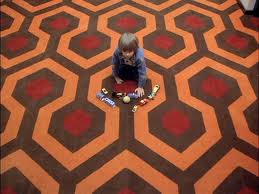
The theories are often outlandish, although the arguers stand firmly entrenched in their reasoning. They find meaning in some of The Shining’s glaring continuity errors: when patterns on the carpet or a chair’s appearance in one scene switches between shots, the theorists insist these mistakes were intentional and have deeply layered subtext that back up their own views.

Ascher does not negate the persuasiveness of the opinions, but lets the audience decide on whether they have credibility or even a shred of sense behind them. He keeps the argument and analysis alive, proving that all of the commentators’ critical work (and no play, considering their fanaticism toward the subject) makes Room 237 not such a dull film.