Welcome!

"In many ways, the work of a critic is easy. We risk very little yet enjoy a position over those who offer up their work and their selves to our judgment. We thrive on negative criticism, which is fun to write and to read. But the bitter truth we critics must face, is that in the grand scheme of things, the average piece of junk is probably more meaningful than our criticism designating it so. But there are times when a critic truly risks something, and that is in the discovery and defense of the new."
-Anton Ego, Ratatouille

With aspirations to become an arts/entertainment reporter or critic, I have started this website to post weekly reviews of the latest cinematic offerings from Hollywood and around the world. Currently studying Film and Journalism at Carleton University in Ottawa, Ontario, I hope my reviews here are the start to a long and fulfilling road down the path of reporting.

Sunday, October 14, 2012

It's Not Going to Stop / 'Til You Wise Up

The Master

**** out of ****

Directed by: Paul Thomas Anderson

Starring: Joaquin Phoenix, Philip Seymour Hoffman, Amy Adams, Laura Dern and Jesse Plemons

Running time: 137 minutes


I am a subscriber to the church of Paul Thomas Anderson, the wunderkind writer/director of Magnolia and There Will Be Blood. His latest film, The Master, is full of mesmerizing performances, exquisite characterization and an accomplished technical precision that one seldom sees on the big screen anymore – or, what is expected from one of cinema’s most strikingly original storytellers.

The Master also marks the fiery return of actor Joaquin Phoenix. He portrays erratic alcoholic Freddie Quell, a naval officer trying to adjust to life away from the shores of World War II. Freddie’s mind is frequently at sea – momentary flashbacks linger on the shiny blues of the ocean, a space of salvation that quells his irrational behaviour.

Detached from the limelight of America in the early 1950s and lost amidst the era’s mores of conservative normalcy, the Salinger-esque figure wanders away from one society and finds refuge in another. While walking around one night while drunk, he boards a boat commanded by a chivalrous, charismatic preacher of sorts named Lancaster Dodd (a mighty Philip Seymour Hoffman).


Dodd takes Freddie under his wing and becomes his spiritual commander, hoping to guide the lost, impressionable soul to nirvana. He is the leader of The Cause, a philosophical movement group that is gaining followers. In the film’s most arresting scene, Dodd submits Freddie to an intense, prolonged session of psychological questioning – what the leader terms “formal processing” – that reveals the traumas of the subject’s life.

Despite the harsh overtones of Dodd’s coldly devout wife, Peggy (Amy Adams), who is deeply concerned about the rage coming from her husband’s new friend, Freddie stays on as a follower, convinced that The Cause can save him from misery and help him find his way on solid ground. However, the process to remove sensations from the rough-edged rascal proves to be arduous for both men.

Although the copyright scrawl at the end of the credits insists that the characters bear no resemblance to real people, Dodd has many similarities to Scientology founder L. Ron Hubbard. The Cause, a hackneyed belief system that focuses on capturing one’s current negative impulses to send that soul back to a state of perfection, may also sound somewhat familiar.


Phoenix is electrifying as the bottled barbaric working to extol his sins. The actor’s tight, disgruntled face masks the character’s simmering wounds to an extent, yet fissures of this aggression erupt in heated convocations with other characters.

Hoffman is just as assured a screen presence but his performance is almost sedate in comparison to Phoenix’s petulant wrath. He portrays Dodd with both an aura of profound wisdom and demure casualness, while compressing a similar rage and distaste for those who don’t align with his views.

Unlike Quell, the audience is only offered hints toward the pain that brought that character down the path to preach righteousness. However, strong supporting work from Amy Adams, fierce and unquivering in moments where she confronts her husband’s burrowed demons, hints that her character may be the master behind the exalted iconoclast.


Mastery is also abound in the film’s technical strongholds, from the choppy dissonance of Jonny Greenwood’s score, orchestrated to reflect Freddie’s tattered psyche, to the period-perfect art and costume design (courtesy of David Frank and Jack Fisk, as well as Mark Bridges). Further, the rhythms of Leslie Jones and Peter McNulty’s superb editing lingers on the raw, unhinged performances, unwilling to cut away.

As with Anderson’s other films, The Master looks at the dysfunction and unlikely reconciliation of a father-son dynamic. The director has explored the themes of incongruent family relationships in Magnolia and There Will Be Blood, while the latter film also dealt with the conflicting ideologies of avarice and faith.

The Master’s tricky power dynamics frequently shift between Freddie languishing under Dodd’s sway and the latter’s psyche becoming dominated by his protégé’s animalistic desire and sexual swells. If Freddie is an id personality, than Dodd is the superego, striving to alter his friend's desires and point his moral compass toward the sea.


Although the titular master’s identity may be up for debate, Anderson’s status as one certainly isn’t. His bold and bizarre journey into postwar American identity is a captivating and complex character study, as well as the year’s best, most daring film.

Friday, October 5, 2012

Pulpy Science Fiction

Looper

***½ out of ****

Directed by: Rian Johnson

Starring: Joseph Gordon-Levitt, Bruce Willis, Emily Blunt, Paul Dano and Jeff Daniels

Running time: 118 minutes


At one moment early in Looper, a character refers to our hero, Joe Simmons (Joseph Gordon-Levitt), as one with “20th century affectations.” Joe dresses like a detective out of a Dashiell Hammett novel and sleeks down the road in a vintage car – quite striking for 2044, the year the film is set in.

But that phrase could have been summing up the sensibilities of writer/director Rian Johnson, whose first two films were Brick, a modern-day high school film where the characters speak like those from hardboiled detective novels, and The Brothers Bloom, a little-seen but enormously clever caper flick with the zip of a Preston Sturges screwball comedy.

Johnson is a director making very original, modern works out of antiquated genres. It is refreshing to see a creative mind so thoroughly invested in constructing a new treat from preserved elements and seeing how the results stitch together. His latest film retreats into the future yet still feels undeniably classic, as if it could have taken place a century earlier.


However, for the time being, it takes place in 2044. Thirty years from then, time travel exists but is outlawed. A future criminal enterprise still uses time machines to dispose of bodies, however, by zapping those people they want to eliminate back to the past, where paid assassins are ready to kill them. Those assassins are called loopers and each one lives in prestige while tent cities sprout up in the streets around them.

One of these loopers is the aforementioned old-fashioned Joe. Equipped with a short-range weapon (nicknamed a “blunderbuss”) in an empty Kansas cornfield on a solemn afternoon, Joe gets a surprise when he comes face-to-face with himself. The target that has been sent back in time to be disposed of is Joe from 30 years into the future.

Old Joe is played by Bruce Willis. A crafty makeup team applied much cosmetic to Gordon-Levitt, puffing up his cheeks and horseshoe eyebrows while sinking his eyes to resemble the action star's.


Old Joe is out on his own revenge plot while Young Joe pursues him, to avoid sacrificing one of the basic rules of the job – never let your target escape. Johnson wisely spends the first 15 minutes setting up the logistics of his futuristic universe and then lets the characters drive the rest of his story, so that the audience is more concerned with understanding their deeper motivations than on trying to piece apart the time travel paradoxes.

Young Joe, like your archetypal sleuth figure, is drug-addled, miserable and having serious caveats about the dangers of his job. A vagrant past has left him lonely and scarred. Old Joe – first introduced in a thrilling if all too brief flash-forward montage – knows that the future is still grim for his younger counterpart.


A diner-set confrontation between the Joes halfway through the film lets both actors dictate the terms. Gordon-Levitt is compelling as the troubled killer who is smoothly losing his grip on his self-control.

Meanwhile, Willis is just as strong (along with Moonrise Kingdom, this has been a stellar year for him). By embodying a man who has not been granted the solace that he once yearned for, Willis is mining deep territory with this role, one which he brings surprising amounts of empathy to.

Audiences can still see Willis unleash the “Yippee-Ki-Yay” during an exhilarating climactic action sequence. But this is a film more concerned with how the characters contemplate their own time – hence the frequent watches and clocks found throughout – than with traveling through dimensions of time. Looper is both an absorbing character drama and richly satisfying pulp pleasure.

Sunday, September 30, 2012

A Bland, Bloody and Blighted Affair

Dredd

*½ out of ****

Directed by: Pete Travis

Starring: Karl Urban, Olivia Thirlby, Lena Headey, Wood Harris and Domhnall Gleeson

Running time: 98 minutes


Judge Dredd is a beloved Dirty Harry-esque law enforcement figure that is popular in British comic book circles. In the latest film adaptation, he is played by Karl Urban, an impressive character actor who is reduced to grimacing, scowling and showing off a handsome cleft chin. See, Dredd never removes his striking red and black helmet.

A by-the-book officer from the Hall of Justice, Dredd patrols the smoggy sprawl of Mega City One, a metropolis of concrete buildings and never-ending highways. The Hall of Justice only has the work force to solve 6 per cent of total crimes.

Beyond serving as a judge, Dredd is also the jury and the executioner, which gives him the right to kill anyone he suspects of wrongdoing. Crime in Mega City One has surged due to Slo-Mo, a narcotic that shows things happening at 1 per cent its normal rate once consumed. 


Slo-Mo is infesting its way through the city's high-rise residential slums (which are just really dirty condominiums). The drug is less a MacGuffin than an excuse for director Pete Travis to indulge in showing hyper-stylized deaths in luscious slow motion.

Our title character is matched up with recruiting a potential judge, Cassandra (Olivia Thirlby), who has potent psychic abilities. She has a scarred past, but her unique powers are resourceful to the Hall. It is Dredd’s job to break her in and to see if her mind is equipped enough to defy the city’s mettle.

The duo head to a slum tower where drug-dealer Ma-Ma (Lena Headey), having infiltrated all 200 floors of the high-rise, has tossed three men from the highest storey, killing them. Upon hearing word of the judges in her building, she locks it down underneath a protective shield and orders that all of the residents take up arms against Dredd and Cassandra.

Dredd's plot, a smackdown between the law and the leeches in a high-rise building, closely parallels that of The Raid: Redemption, an explosively energetic martial-arts fiesta that came out earlier this year.


Instead of having that film's riotous, high-octane energy, Dredd settles for less carnage and chaos. The action sequences, which are seldom and seldom easy to decipher, are bludgeoned with a chaotic techno soundtrack and CGI splatter, making the on-screen violence resemble more of an arcade shoot-em-up than a well-storyboarded assembly of image and sound.

Dredd’s dreary, metallic sets make it look like any average video game, although one that’s hard to participate in. More disappointing is how few obstacles there are for Dredd and Cassandra to overcome throughout the film's middle section.

Short on fury and conflict, the film's script, by Alex Garland of 28 Days Later fanfare, only resonates with Cassandra's character arc. The young recruit struggles with choosing between regular civility and the haunting acts of violence she would have to commit as a judge, and it's the only notable character detail within the film.


Urban’s growl makes the cadence of the cartoonish dialogue more interesting, but beyond his helmet shell, it's a fairly non-descript law enforcement role. Lena Headey’s Ma-Ma is even blander, a barely menacing villain that, like the film, has little personality.

Wednesday, September 19, 2012

Don't Trust the B**** from the Other Line

Compliance

*** out of ****

Directed by: Craig Zobel

Starring: Ann Dowd, Dreama Walker, Pat Healy, Bill Camp and Philip Ettinger

Running time: 91 minutes


Compliance is a tense, terse drama that beckons the audience to ponder how they would react to the onscreen events if they were present in the circumstances of the story. At many moments throughout my screening, I coughed out some nervous laughter, trying to figure out whether the proceedings – based off shocking true events – were worthy of a laugh, a gasp or a combination of the two. The story may be sickening, but it is told with expert performances and direction.

The bulk of the film takes place behind the back counter of a fast food eatery on a busy Friday evening. Stressed out middle-aged manager Sandra (Ann Dowd) gets a phone call from a police officer explaining that one of her employees, a pert, unblemished teen named Becky (Dreama Walker), stole money from a customer that afternoon.

The officer tells Sandra to detain Becky until the police can come and investigate. Sandra obeys the officer, even when he summons her to check Becky’s purse and pockets for the allegedly stolen cash. Then, he tells Sandra to perform a strip search. Although both women are uncomfortable with this demand, the officer explains that the flip side would be to jail Becky until the police could check for themselves.


The tension quickly escalates as Sandra obeys the man’s direction without much discretion of her own. Halfway through Compliance, as the officer’s demands veer to the queasy side, we get a face to match the voice on the phone. It turns out that the man is not a police officer but an everyman (Pat Healy) in a nice home who is using a calling card as a means for a humiliating crank call.

As the scenes move between his comfy home and the stuffy confines of Sandra’s office, there is a disorienting (yet effective) juxtaposition between the caller’s joking smile and the victim’s uncomfortable submission.

The situation in the film — believe it or not – is closely based on a crank call to a Kentucky McDonald’s location in 2004. In fact, that horror story was actually more sordid and sexually degrading than the acts depicted toward the end of Compliance, which are implied or blurred out. (The truth, it turns out, is not stranger than the fiction, but is just as sickening.)


Compliance is a pressure-cooker full of arresting performances, most notably from Dowd and Walker. In the first half, before showing the man behind the curtain, Zobel contends with lingering reaction shots on his two antagonizing females. Dowd’s nuanced but troubled shifts between sternness and sympathy is as assured as Walker’s slow interior descent into submission.

Zobel has mined terrific gold from his leading actresses, although he is a tad clunky as a storyteller. To segue from scene to scene, he awkwardly puts in exterior shots of the restaurant parking lot and close-ups of frying chicken fillets, One nighttime scene shot in broad daylight also sticks out like a burnt McNugget.

Regardless, he keeps the tension impalpable and the proceedings unpredictable. Compliance stirred up much discussion at its Sundance debut earlier this year, and rightly so: it’s a film worth talking about, a sharp, slim and sociologically fascinating dissection of power and control. 

Saturday, September 8, 2012

Summer 2012 Recap


This summer's selection of movies didn't stray too much from the typical seasonal template: a few films delighted (such as Moonrise Kingdom, the best film Wes Anderson has ever conceived), a few films crashed and burn (such as the star-studded but vapid Rock of Ages) and most failed to live up to audiences' expectations (The Bourne Legacy, The Dark Knight Rises).

Despite kicking off in early May with The Avengers, the record-breaking superhero extravaganza, this summer was one of the least-attended summers on record at North American theatres since 1995 and actually sold around 5% fewer tickets than last year's comparable season (that was buoyed by the final Harry Potter film). 

Unfortunately, this summer movie season will likely be remembered for the disturbing shooting in Aurora, Colo., where 12 people were killed and 58 injured at a midnight screening of The Dark Knight Rises. This mass murder disrupted the great pastime of going to the movies for millions of people.

Despite the tragedy, moviegoers still opened their wallets to a diverse amount of mainstream and independent fare. Within the season, I went to see 11 films. Here are small capsule reviews of the finest films, as well as the biggest follies, of the summer. The films are rated out of four stars.


Beasts of the Southern Wild (***½)

Remember the name Quvenzhane (pronounced Kwah-VEN-ja-nay) Wallis, and prove your expertise by enunciating her name correctly when those presenting her with awards next season get it wrong. She was just six years old during the filming of Beasts of the Southern Wild, a striking and deeply compelling glimpse into a vibrant Louisiana shantytown community called “the Bathtub.” Wallis is Hushpuppy, a feisty tot unprepared for the gusty torrents of Hurricane Katrina (which fills her “Bathtub”), and the debilitating health of her father (Dwight Henry) as he tries to teach her how to survive in such squalor. The young actress is a firecracker of equal parts energy and pathos, carrying Benh Zeitlin’s debut – an award winner at Cannes and Sundance – on her tiny shoulders. It’s a debut film that is intense and sensory, like the crackling cajun flavours that heat up the frame, while also deeply moving, especially when Wallis stands front and centre, defiant and proud.


Brave (***½)

Set in the magic kingdom of mystical Scotland, Brave follows Merida (voiced by Kelly Macdonald), a princess that defiantly opposes the stern expectations of her mother, Queen Elinor (Emma Thompson), by aligning herself with sport and adventure. Elinor demands that Merida strive for prim, womanly perfection so a suitor can pick Merida as his bride. The mother-daughter conflict leads to an affront where an act of dark magic stains their relationship and relies on breaking a powerful curse to undo. Toon giant Pixar continues to raise the bar for breathtaking animation, while maintaining its stronghold on creating dynamic character relationships - here done by richly exploring the family ties of some feisty royal Scots. A terrific merge of Disney’s signature classic fairy tale formula with the poignancy and ingenuity that made their animation company the most lucrative (and critically acclaimed) in the world, Pixar’s 13th feature is a return to form after their first disposable offering, Cars 2, was released in 2011.


The Dark Knight Rises (***)

The finale to one of this century’s greatest big-budget franchises, Christopher Nolan’s Dark Knight trilogy, is arresting, although unwieldy, entertainment. Eight years after Batman becomes Gotham’s scapegoat to cover up the fall of famed attorney Harvey Dent, Bruce Wayne (a commanding Christian Bale) decides to don the suit once more. His adversaries include a super-strong terrorist with a face-hugging mask named Bane (Tom Hardy) and Selena Kyle, a slithery jewel thief (Anne Hathaway), while his allies include noble police officer Blake (Joseph Gordon-Levitt). Nolan’s film remains steeped in contemporary conflict, from the social and financial instability that launched the Occupy movement to fears of nuclear catastrophe. As a result, Rises has a simmering urgency and intensity, as well as a moral greyness, that more simplistic action spectacles lack. But while Nolan’s other installments were taut and thrilling, his finale feels weighed down by an abundance of characters and exposition.


The Bourne Legacy (**½)

Author Eric Van Lustbader took the reins of Robert Ludlum’s bestsellers after the late novelist died in 2001. Meanwhile, Jeremy Renner takes the leading role for this updated series, based on Lustbader's follow-up, replacing Matt Damon. But the breathless pacing and taut plotting of the earlier entries, which mirrored Ludlum’s, is in shorter supply here. Renner is intense as Aaron Cross, more perceptive and thorough than Damon’s Bourne. He is joined by a chipper (and terrific) Rachel Weisz as his hostage, a doctor who can help viral him off the drugs that genetically enhanced Cross to kill. Legacy has strong performances and punchy action sequences (including a chilling lone man shooting at a science lab), but it is an inefficient film. It sets up the story instead of following through with it. Perhaps siphoning off some of the oblique office-set scene, featuring a panicked Edward Norton, and less jetpacking around the world could have saved some time.


Safety Not Guaranteed (**½ )

A six sentence classified ad may be a peculiar inspiration for a feature-length film, although for one as modest as Safety Not Guaranteed, a charming if thinly drawn sci-fi comedy, it works just fine. If remembered for anything, it will be for turning actress Aubrey Plaza from a queen of deadpan quirk on the small screen to a nuanced big screen star. She plays Darius, a shy college grad interning for a Seattle publication, who ends up befriending Kenneth (Mark Duplass), the subject of an investigative report she pursues. He wrote a mysterious wanted ad asking for a partner to go back in time with him, insisting that this expedition is not a joke. Duplass and Plaza are terrific as lonesome strangers looking for enlightenment and their heartfelt chemistry elevates Safety above the sitcommy extensions of Derek Connolly’s script. Subplots involving Darius’s co-workers, a smarmy, demoralizing writer (Jake Johnson) and a nervous South Asian intern (Karan Soni) are thinly conceived and merely reinforce the themes of the film without bringing added depth.


The Campaign (**)

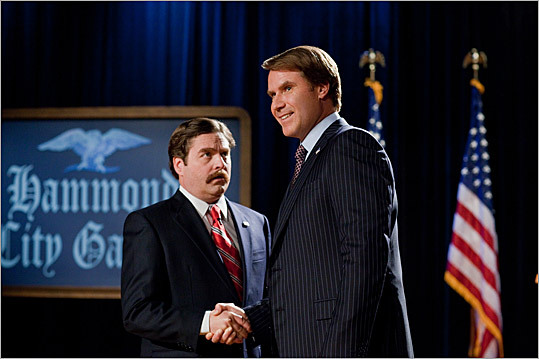
Director Jay Roach helmed two of the most successful comedy franchises of all time (Austin Powers, Meet the Parents) and brought two exciting election stories to HBO with the films Recount and Game Change. So, his latest project, an attempt to bridge his broad, big-screen farces with his sharper, scandalous political fare, should have been a home run. However, Roach and writers Chris Henchy and Shawn Harwell go for the obvious rhetoric and rhyme when a slyly, more satirical angle would work best with The Campaign, which stars Will Ferrell and Zach Galifianakis. Ferrell is Cam Brady, a Democratic Congressman who puts more effort into his soothing crowds with his charming, patriotic speeches than with his political agenda. Galifianakis, meanwhile, is Marty Huggins, a lovably wholesome hick forced to go to desperately lewd measures to unseat the reigning Congressman. When the two comedy titans lead the material, as in several cheeky debate scenes, the results are often frank and funny. But the script delves into sketch comedy territory too often, relying more on caricatures and outrageous sight gags.


Killer Joe (**)

As the slinky part-time detective, part-time eponymous contract killer, Matthew McConaughey deftly skirts the line between chilling and chivalrous. When the actor, currently riding a mid-career boost, is on screen, he is magnetic (to the extent that one of the characters refers to Killer Joe’s menacing glare by saying “his eyes hurt.”) But this sordid piece of Southern suspense-comedy, adapted from a Tracy Letts play and directed by William Friedkin, falters whenever McConaughey vanishes. During these moments, the audience is left to deal with a snivelling family of trailer trash, speaking at various octaves – from Emile Hirsch’s yelping as the drug-dealing son to the virginal signs of Juno Temple’s sacred teenage daughter Dottie. For the film’s duration, McConaughey’s performance is crisply attuned to the bubbling darkness underneath the slick wardrobe. But this Southern dysfunctional variation on Billy Wilder’s Double Indemnity sharply veers from family drama to black comedy to campy exploitation without much coherence. 


The Amazing Spider-Man (*½)

In the case of superheroes Batman and The Hulk, rebooted entries can invigorate the character and their story universe with a fresh jolt of quality. Unfortunately, The Amazing Spider-Man, released just five years after the reviled Spider-Man 3, doesn’t. It is a lifeless film with lazy screenwriting and poor characterization. Andrew Garfield is a terrific actor but is entirely unconvincing as high-schooler-cum-webslinger Peter Parker, too old and not nebbish enough to make an impression. He is surrounded by a plot woven by scenes so mechanically composed, they feel contrived. In several moments, the characters behave as if controlled by mannequin screenwriters, ushering them to behave in one way to pertain to the web of the story instead of letting them act and react organically. The action feels forced while the action sequences and CGI are just as unconvincing. The Amazing Spider-Man doesn’t come close to living up to its hyperbolic title. It’s just an astonishingly insipid and unnecessary remake that removes the campy thrills made Raimi’s installments so much fun.


Ruby Sparks (*½)

Ruby Sparks is a high-concept dramedy with the fantastical premise of a struggling, paranoid writer, Calvin Weir-Fields (Paul Dano) realizing that the character he is writing can actually come to life in front of him and be controlled by his words. She is the title character and is played by Dano’s real-life girlfriend, Zoe Kazan. The film, the sophomore feature from Little Miss Sunshine directors Jonathan Dayton and Valerie Faris (also a couple), has the opportunity to appeal as both a comedy and a tragedy. It could be the former by highlighting the quirkiness of the circumstances, showing the unpredictability of a relationship nurtured between a writer and his character (and their eventual best-selling life together). It could also be tragic by aligning Calvin and Ruby with a master-slave dynamic, having her actions continually submit to his thoughts and words. However, Ruby Sparks – which was written by Kazan, the granddaughter of director Elia – never figures out what it wants to be and meanders from scene to scene without much of a destination for these twee characters and the peculiar premise. Sparks has a clever idea that never fully forms into much of a film.


Ted (*½)

Ted is a story about a boy and his teddy bear. But since the film comes from the mind of lewd Family Guy creator Seth MacFarlane, the teddy bear is a profane pothead with a penchant for beautiful blondes. The comedy hit, a debut for MacFarlane, delves its central conflict from the commitment issues that arise when that boy becomes a man (played with deadpan conviction by Mark Wahlberg) and decides to move on, Jackie Paper-style. However, this debut is sophomoric and uneven, where scenes revolve around lame jokes – possibly ones found under the writing room tables from the handful of shows MacFarlane produces – instead of story progression. Strangely, it’s the raunchy talking teddy who is given the most humanity. Everyone else is a walking stereotype: the women are often shallow, dim-witted and long legged, while the men are clumsy or spiteful, usually both. Meanwhile, the results of the comedic setups are only intermittently funny. Ted would feel more at home on the small-screen sitcom format where 22-minute bursts of subversive humour would work better than this 106-minute breath that continually feels as if it clinging for comedy air.


Rock of Ages (*)

Rock of Ages, based on the Broadway jukebox musical, is the cinematic equivalent of listening to Starship’s 1985 single, “We Built This City,” on repeat for two hours. Like the much-maligned song, it has the spirit of rock and roll at its soul but delivers this message with such airless artifice that it ironically undercuts the power of its subject. The film transforms the throttle and sexuality of a 1980s rock ballad into sugary pop music, while trying to balance four mediocre plot strands. The one given the most screentime is a bland puppy love romance between Julianne Hough and Diego Boneta, who barely make an impression. Meanwhile, Tom Cruise oozes a faint glimmer of sex appeal, not an ounce of body fat and – like the rest of the cast – a merely satisfactory vocal range as Stacee Jaxx, a coked out, mink-wearing, Bret Michaels-Axl Rose hybrid. As difficult as it is to loathe the well-meaning ensemble, including such actors as Alec Baldwin and Catherine Zeta-Jones, several of their musical numbers are torturous to endure. Few of them have the vocal chops to convincingly sell such ache and grind. This tone-deaf movie never ends: it goes on and on and on and on.