Welcome!

"In many ways, the work of a critic is easy. We risk very little yet enjoy a position over those who offer up their work and their selves to our judgment. We thrive on negative criticism, which is fun to write and to read. But the bitter truth we critics must face, is that in the grand scheme of things, the average piece of junk is probably more meaningful than our criticism designating it so. But there are times when a critic truly risks something, and that is in the discovery and defense of the new."
-Anton Ego, Ratatouille

With aspirations to become an arts/entertainment reporter or critic, I have started this website to post weekly reviews of the latest cinematic offerings from Hollywood and around the world. Currently studying Film and Journalism at Carleton University in Ottawa, Ontario, I hope my reviews here are the start to a long and fulfilling road down the path of reporting.

Sunday, June 6, 2010

Art For Our Sake

Exit Through the Gift Shop

**** out of ****

Directed by: Banksy

Starring: Banksy, Thierry Guetta, Shepard Fairey and Rhys Ifans

Running time: 87 minutes

It was pop artist Andy Warhol who prophesied that, “In the future, everybody will be world famous for 15 minutes.”

And it is Bansky, a notorious guerilla art phantom that - like Warhol before him - forays into film to deliver a fascinating look into the psyche of celebrity and the underground world of street art.

His debut, Exit Through the Gift Shop, may be a thought-provoking, howlingly funny and thrillingly original documentary. It also may not be a non-fiction feature at all.

Since it debuted at Sundance, critics and audiences have questioned if the events in Gift Shop have any validity, and if sections are purposefully fake to coincide with the challenging questions Banksy – a modern art auteur if there ever was one – throws at us.

(I will refrain from delving too far into the details surrounding the claims that the film is contrived and manipulative – there’s no point in spoiling the pleasures for you folks.)

Gift Shop is a film about a documentarian, and one that's hard to forget: an unabashed French shop keeper named Thierry Guetta. He bumbles his English like Inspector Clouseau and a decade must have passed since his barber trimmed his sideburns.

Guetta discovers that his cousin is a rising street artist in Los Angeles. Street art is a term given to artworks that are placed in public spaces, and range from traditional graffiti to stencil art to wheatpasting.

His cousin specializes in pasting mosaic tiles of characters based on those from the video game Space Invaders, and the young artist begins to dub himself as “Invader.”

Captivated by his cousin’s entrance into an exciting new genre of modern art, Guetta begins to follow Invader around and record the genesis of his guerilla-art career during late-night missions across Los Angeles. The results of these adventures fill box after box of tape, and it’s not long until Guetta should just have his camcorder surgically attached to his hand.

The danger of recording this movement excites Guetta, and the eager videographer decides to expand his focus. Like a paparazzo, albeit an incredibly loyal one, Guetta begins filming other successful street artists, such as Shepard Fairey (notable for his ubiquitous “Hope” poster for the Obama campaign).

With his camera being the sole eye capturing the spray, Guetta tasks himself to create a documentary about the evolution of street art – as a result, much of Gift Shop is dimly lit and handheld.

Of course, this journey requires him to enter the upper echelon of the underground art world to find the reclusive success, known simply as Banksy.

While Banksy’s face appears in the shadows throughout the film's duration, and his voice is distinctly altered to keep his identity a mystery, other street-art figures, whose pieces are illegal and unsanctioned, brave the camera and show their faces. It is liberating to see these young creators bare their identities and show off their works, many of which are sublime.

Graffiti may be considered reprehensible, and much of what is sprayed onto alley walls have similar attributes to that of a toilet bowl. But there is a breathtaking amount of pleasure in watching subversive underground artists craft these bold, bizarre and sacred works, and set them up before unsuspecting pedestrians. Through Guetta’s camera, this world blossoms to life.

But Exit Through the Gift Shop is not merely an effort to broadcast the triumphs of a brazen art movement – it doesn’t try to paint these artists as heroes with spray cans.

Instead, Banksy’s film targets the phonies and the posers who withhold any artistic integrity. They are the people who decide to go the way of the film’s title, capitalizing on art by crafting works as a method for commerce rather than for expression.

We live in an age where the value of making concrete art has fallen by the wayside in a race for hype, fame and cash. Advertisements come from digitally altered images and their creators still win awards. People can become celebrities by uploading their videos onto YouTube or entering televised competitions, and are soon clearing their mantle for Grammys galore. What qualifies as true art anymore?

So, what happens when Guetta decides to ditch the camera and become his own street-art persona? The results may surprise you.

Gift Shop is one of those rare occasions where I can describe a film as “brilliant.” It brims with zest and humour and intrigue. It's an exciting look into a mysterious genre of art for the first hour, and then stops on the fly to turn into a potent analysis of the meaning of “art” in today’s society and what the term now connotes.

But whether or not Exit Through the Gift Shop is a “prankumentary,” as one critic has coined, there’s no denying it’s a one-of-a-kind treat: a movie that celebrates art that’s also a work of art worth celebrating. And that’s no joke.

Tuesday, June 1, 2010

He's Out of Their League

The Trotsky

*** out of ****

Directed by: Jacob Tierney

Starring: Jay Baruchel, Emily Hampshire, Colm Feore, Saul Rubinek and Anne-Marie Cadeiux

Running time: 114 minutes

All high school comedies may be created equal, but The Trotsky is one that comes more equal than the others.

Headlined by a triumphant performance from rising Canadian actor Jay Baruchel and boasting with refreshing intelligence, The Trotsky is a delightful twist on a typically lowbrow genre.

Most films set at high schools stick to the modern day slang, fashion and hot-button teenage issues. The Trotsky, on the other hand, keeps its spirit rooted in Russian history (although the jokes about Stalin and Ayn Rand will resonate best if you weren't falling asleep in history class).

The comedy follows Leon Bronstein (Baruchel), a Montreal high-schooler who has convinced himself that he is the reincarnation of Bolshevik revolutionary leader Leon Trotsky.

An agenda in Leon’s room – a running joke throughout the film – outlines his industrious path, involving exile, marriage, assassination and meeting Vladimir Lenin (but not necessarily in that order).

His father (Saul Rubinek) believes that Leon is a head case – especially after he organizes a union among his dad's factory workers. Bewildered by his son’s irrefutable mindset, he drops Leon out of boarding school and enlists him in one of Montreal’s strictest private schools, headed by Lenin look-alike (for obvious reasons) Principal Berkhoff (Colm Feore).

With his skinny suits, Eraserhead hairdo and knack for making proclamatory speeches, Leon stands out among the rest of his senior class. With his school union (who merely stand there while he does the talking), Leon starts to implement some revolutionary ideas to liberate the apathetic high school masses.

He also falls for a hot-headed graduate student named Alexandra (Emily Hampshire), who Leon is keen to marry to keep with the thrust of his idol’s biography (Trotsky also married an older woman with that name).

Baruchel omits amazing range as our determined protagonist. Once resigned to wimpy supporting turns (Tropic Thunder, Knocked Up), the Montreal-born actor has matured into a credible leading man.

This is not a tiresome one-joke premise (and thank goodness it isn't). Baruchel's Leon Bronstein is an eccentric and noble teenager who speaks like a grown adult twice his age, but cannot mask a sincere teenage awkwardness underneath, especially in his sweet-natured coffee outings with Alexandra.

The mix of staunch integrity and romantic inexperience leads to a turn both dignified and charming. He may have visions of grandeur, but Leon’s still a teenager, ensuring that Baruchel’s performance resonates on more than just one stagnant emotional level.

Unfortunately, while Baruchel anchors the film, the rest of the characters are forced to be swept underneath his current. Writer/director Jacob Tierney forgot to give the other characters and story elements the time to breathe.

The most potent example of this is the Leon-Alexandra romance. In the first half, the comedy and conflict work: she is tired by his never-ending proposals of marriage, but the young Bolshevik-imitator is eager to offer his hand. But as his Russian revolution (of sorts) takes off, the love story is ignored, and therefore its resolution feels sudden and rushed.

Still, while nodding to Russian history, The Trotsky is proudly Canadian. From jokes about Ben Mulroney to the snazzy Montreal locales to a throbbing soundtrack with K’Naan and local Quebec rockers supplying the beats, there’s no denying where the film was set.

Having Canadian veterans Colm Feore as the dastardly principal and Genevieve Bujold as his rigid superintendent are inspired touches, indeed.

Some of the storylines may be left in exile, but Baruchel single-handedly leads The Trotsky to the heights of a minor classic, for both Canadian comedy and the high school genre. And I'm really curious to see how Leon ends up at university.

Sunday, May 23, 2010

Rebel With a Cause

Robin Hood

**1/2 out of ****

Directed by: Ridley Scott

Starring: Russell Crowe, Cate Blanchett, Mark Strong, Oscar Isaac and Max Von Sydow

Running time: 140 minutes

With financial woes plaguing the European Union and a slowly adjusting global economy, will audiences choose to escape into a time where “taxation” was still the word on everyone’s lips?

From the medieval look to the gritty battle sequences to the collaboration with Russell Crowe, Ridley Scott’s latest retelling of the legendary Sherwood Forest archer was marketed as “Gladiator: The Return of Maximus.”

Instead, Robin Hood is "Gladiator Lite," with less rousing action, fewer compelling characters, and an alarming lack of personality. Nevertheless, it is still an enthralling and magnificently filmed origin story.

Moviegoers may be expecting a rehashing of story elements that they are familiar with. But beware: this is a prequel to the Hood's title as Prince of Thieves.

Long before he was labelled an outlaw and robbed the rich to give the poor their coin, Robin Longstride (Crowe) and his gang of marauders served England in the Third Crusade.

When their leader, Richard the Lionhearted (Danny Huston) dies in battle, Robin and his troupe of soldiers decide to return home. On their journey, they come across a pillaged band of knights, one of whom is breaths away from his end. That man is one Sir Robert Loxley of Nottingham, and he wants Robin to return his sword to his father.

Longstride vows to do so. Upon meeting the penniless population of Nottingham, he finds Loxley’s widow, Lady Marion (Cate Blanchett), and father, Sir Walter (Max Von Sydow), to whom he returns the weapon.

He further vows to defend the poor community from the harsh taxes summoned by the newly crowned King John (Oscar Isaac) and his errand boy sent to collect the bill, Sir Godfrey (Mark Strong), who’s also secretly an agent of France.

Gone is the dreamy Technicolor of the Errol Flynn classic. These new adventures are nearly drained of colour, but Scott’s signature epic sweep makes up for the lack of green-cloaked merriness.

The attention to detail – from the grand medieval locations to the costumes – is rich. Moreover, the battle sequences are thrilling, including a triumphant storm-the-beaches finale that plays out like D-Day in reverse. Robin Hood looks medieval and feels like a brawny summer blockbuster.

Unfortunately, the characters could have used some polishing. The film is overstuffed with three villains (too many), a cluster of Merry Men (ditto) and several helpful aides, including Mark Addy as Friar Tuck and William Hurt as a loyal servant to the King.

The attempts to introduce each supporting character makes the film lag, and their lack of development ensures that they quickly become dispensable within the story.

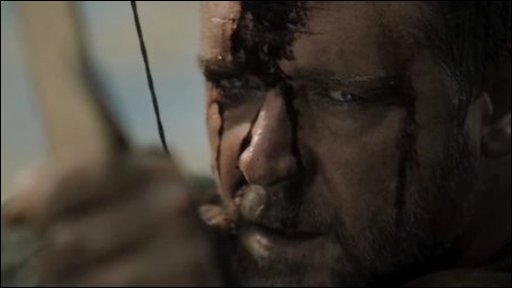
Furthermore, Russell Crowe’s take on the Hood is not quite a bullseye. For an actor known for intense, fiery, strong-willed performances, you hope for Robin to show some charisma while jump-starting a drive to justice:

Unfortunately, dull characterization from the often-reliable screenwriter Brian Helgeland (L.A. Confidential, A Knight's Tale) ensures that even Crowe seems too bland to bring the character a strapping action-hero status.

Blanchett fares better, as Marion (notably without the “Maid” preceding her name). She is a woman of substance and fierce intelligence. She is everything that Crowe's portrayal should have allowed him to be - it’s no wonder she turns up as a warrior alongside him in the final minutes of the film.

Most fascinating, though, is the currency of the subject matter. Depending on your political leanings, Robin Hood is either the Barack Obama of 13th century England (with his libertarian ideals) or the ultimate Tea Party representative (one who demands “no taxation without representation.”)

The battle scenes have might, the political conflict has intrigue, and the costume and production design is layered with detail. It’s too bad that many of the characters in Robin Hood lack these preceding traits.

These adventures of Robin Hood and Co. are solid but ultimately flavorless. Where’s Errol Flynn when you need him?

Wednesday, May 19, 2010

This "Dragon" is Never Draggin'

The Girl With the Dragon Tattoo

***1/2 out of ****

Directed by: Niels Arden Oplev

Starring: Michael Nyqvist, Noomi Rapace, Sven-Bertil Taube, Peter Haber and Lena Endre

Running time: 148 minutes

Fervent readers across the world – those who have outgrown tales featuring hormonal wizards and Abercrombie & Fitch models posing as werewolves – have been firing through the “Millennium Trilogy,” from Swedish author/journalist Stieg Larsson.

Larsson’s trilogy was finished but unpublished when he suddenly died in November 2004. Since then, his books (released posthumously) have sold over 30 million copies worldwide. The Girl With the Dragon Tattoo is the first installment in the trilogy.

And even though an American remake of the bestseller is in the works – likely to be helmed from Fight Club director David Fincher – it would be unwise for anyone, bookworm or not, to miss this gripping adaptation. Even one that’s entirely in Swedish.

That girl with the dragon tattoo scaling her back has a name, and it’s Lisbeth Salander (she's portrayed by Noomi Rapace).

She wears coarse, black clothing, is covered with piercings, swears profusely, and earns a living as an undercover investigator, craftily obtaining private documents and hacking her way through hard drives. She’s a compelling hybrid of shock rocker Marilyn Manson and the snooty (and fictional) Chloe O’Brian, from Fox’s hit series 24.

Her last name may be Salander, but in Dragon Tattoo, she delves into the life of an alleged slanderer, a disgraced journalist named Mikael Blomkvist (Michael Nyqvist).

Blomkvist, a publisher for a thriving financial magazine, has been sentenced to a six-month prison term for losing a libel case against a powerful Swedish industrialist. After being defamed for his actions, he hastily agrees to assist an aging billionaire, Henrik Vanger (Sven-Bertil Taube).

Forty years prior, Vanger's niece, Harriet, disappeared from the island that houses the lofty family estate and was never seen again.

Haunted by the cold case, Vanger believes that his niece was killed and that her perpetrator is still out there. He wants Blomkvist to crack the unsolved mystery by bringing a fresh, journalistic perspective to the investigation.

Before long, our new detective gets a major break in the case, courtesy of someone who’s keeping close tabs on Blomkvist: a young woman with a dragon tattoo. Together, Blomkvist and Salander form an unlikely detective duo to get to the root of the decades-old mystery.

Blomkvist and Salander are an unlikely combination, but Nyquist and Rapace, respectively, give their coupling a scalding hot chemistry amidst a chilly, barren atmosphere.

Both characters are lost and vulnerable. Salander has been depraved by a sadistic guardian (warning: there are some graphic scenes of rape and mutilation here). Also, Blomkvist can’t walk very far without being reminded of his journalistic collapse.

Nyquist and Rapace offer these beloved literary characters a sardonically bitter edge in the first third. But, as we uncover more about these lonely souls and get caught up with their shattered lives, we begin to buy their inevitable romantic pairing.

Major props go to Rapace, who looks the ferocious part while offering glimmers of tenderness underneath. Good luck to the casting director of the upcoming US remake for finding someone of equal worth.

Furthermore, there aren’t many times when an adaptation – especially one for such a sprawling, intricate novel like "Dragon Tattoo" – can remain in-sync with the characters without missing the elemental aspects of Larsson's dense plotting.

The film is taut, and never feels the need to swerve into the subplots involving secondary characters that were wisely left on the page.

Director Niels Arden Oplev ensures both excellent pacing and breathless suspense. When one can be so engrossed with the mystery at hand that they no longer feel as if they’re reading the subtitles but breathing in the intricate details of the story, it's fair to say that this is a worthy tribute to Larsson's page turner

Even so, it’s odd that the novel’s potent MacGuffin is absent. In the novel, Blomkvist agrees to investigate for Vanger in exchange for information that would prove that the man who initially sued him for libel is indeed corrupt. Blomkvist’s immediate involvement with Vanger in the film version - without the exchange - is hard to buy, as a result.

Regardless, this is intelligent, riveting entertainment. The Girl With the Dragon Tattoo brings out the vivid characters, unsettling portrayals of violence and malice (that are key to the story at hand), and the encapsulating whodunit that has already left millions of readers licking their lips for more.

It’s as if the zeniths of Larsson’s opus had been tattooed onto the reels of the film. Take note, Hollywood: this is how a beloved novel's adaptation is done right.

Tuesday, May 11, 2010

Man With The Iron Suit

Iron Man 2

**1/2 out of ****

Directed by: Jon Favreau

Starring: Robert Downey Jr., Gwyneth Paltrow, Mickey Rourke, Scarlett Johansson, Don Cheadle and Sam Rockwell

Running time: 124 minutes

Everything that went brilliantly right with the first Iron Man film – the spot-on performances, the irresistible charm of narcissistic playboy protagonist Tony Stark, a flurry of amusing laugh-out-loud moments uncommon of the superhero genre – is also present in its sequel.

So why does Iron Man 2, the first mega-blockbuster of the summer, feel so unsatisfying?

This model may be flashier and features a broader array of gadgets than its predecessor, but when put together, the parts don’t complement each other to serve an efficient, focused, well-balanced whole. It's grandly entertaining, but also overloads itself with underwritten subplots.

In this installment, Tony Stark (Robert Downey Jr.) is enjoying his enlarged celebrity status by keeping the world safe and secure with his Iron Man technology. While fame goes to his head, the palladium chemical in his armor suit slowly kills everything else inside him.

Uncertain of whether he can be saved by a substitute element, Stark gives his former assistant, Pepper Potts (Gwyneth Paltrow), his company's CEO position. He starts drinking, too.

While Tony’s death begins to seem imminent, it becomes the least of his concerns.

A Russian physicist named Ivan Vanko (Mickey Rourke) is keen on revenge. Vanko's father, who collaborated with Stark’s daddy before banishment to Russia by Stark Industries and a miserable life in poverty, dies.

Vanko has created an arc reactor to thrash (or more appropriately, give “Whiplash” to) our steel-cloaked protagonist, to honour his father's accomplishments and demonize Stark Industries.

Furthermore, a rival weapons manufacturer, Justin Hammer (Sam Rockwell), is poised to shame the billionaire playboy in front of the US Congress – where Tony is summoned to give up his technology – while upping the ante with new warfare of his own.

Finally, Pepper's replacement arrives in the form of a very sultry and mysterious young woman named Natalie Rushman (Scarlett Johansson), who Tony is eager to seduce.

A sequel needs to deliver more, but not in the ways Iron Man 2 delivers “more.” The storylines of characters we’ve grown to adore – Tony, Pepper, Rhodey (Don Cheadle, replacing Terrence Howard after a contrast dispute) – are stilted in their development to make way for plenty of subplots involving new characters.

Screenwriter Justin Theroux (Tropic Thunder) has followed in the footsteps of other inferior superhero sequels (X2: X-Men United, Batman Returns, Spider-Man 3) by adding a new group of characters without adding to the complexities to the characters that were already there.

The film shrugs off the engaging personal drama of one of comic lore’s most charismatic figures, the insatiable Tony Stark. Theroux introduces the idea of Tony being Iron Man’s biggest adversary, but does little with it.

When your protagonist is throwing his life away on liquor, (especially when he’s portrayed by a post-rehab Downey Jr.), the drama aches to become candid and entirely compelling. Instead, it resolves itself quickly with a clanky battle between Iron Man and his metal sidekick, War Machine, set to the beats of Queen and Daft Punk.

Furthermore, it doesn’t help matters when your villains aren’t, well, all that bad. Rockwell's Justin Hammer is a plucky rival for Stark, but even though his deliciously obnoxious portrayal recalls a PG-13 hybrid of Ari Gold and Gordon Gekko, he’s a one-dimensional creation.

Ditto to Vanko, who is ready to thwart Tony as a way to expose the darker undercurrents of Stark Industries. But there is little development within his tale, as well.

This intriguing means to explore the question of good and evil of our protagonist, his father, and the morality of their weapons manufacturing is shoved aside entirely. Didn’t these questions of moral ambiguity help make The Dark Knight such riveting, thought-provoking entertainment?

Regardless, even when the characters and their storylines aren’t developed to their potential, the performers are excellent.

Downey Jr. continues his dry, sarcastic quirkiness as our cocksure hero, while Paltrow is wonderful as his intelligent but cautious aide, playing both companion and character foil to our snarky hero. Their scenes together are the highlights of the film.

Director Jon Favreau, who helmed the original, has also become more confident with filming action sequences. Iron Man 2's big-budget FX setpieces are dazzling, nimble and (refreshingly) shot and edited in a clear and cohesive manner. We can see the battles between Iron Man and Whiplash without suffering from whiplash ourselves.

But when all is said and done, Iron Man 2 is merely serviceable. While some parts - mainly the action sequences - are Marvel-ous, other sections - mainly the character driven ones - feel stagnant and disposable.

That’s what happens when more time is focused on the machines than to the people inside of them.